

GOVIS 2026: Reflecting on courage to deliver

The annual GOVIS conference brought together digital practitioners from across Aotearoa New Zealand at Te Puna Mātauranga o Aotearoa National Library of New Zealand in Wellington. Held across 29 and 30 July 2026, this year’s theme, "Courage to deliver", challenged attendees to move beyond broad transformation ambitions and focus on practical execution, system stewardship, and sustainable delivery for the public good.
Following a mihi whakatau from Kurt Komene and Ali Houpapa of Taranaki Whānui ki Te Upoko o Te Ika, GOVIS President Mick Crouch opened the 2-day event. Silverstripe was proud to sponsor the conference and join the conversation alongside agency leaders, innovators, and international speakers.
Execution over ambition in government transformation
In his opening address, Public Service Commissioner Sir Brian Roche set a clear tone for the event: government agencies have discussed digital transformation for years, but success relies on execution rather than ambition alone. Delivering digital services that work for all New Zealanders requires confronting legacy complexity, simplifying systems, and building unified experiences.
Sir Brian Roche joined Chris Fechner, Chief Executive Officer of Australia’s Digital Transformation Agency, in a panel chaired by Steve Griffin of Assurity Consulting. The discussion focused on system-level thinking, overcoming risk aversion, and making smaller, iterative investments instead of large, expensive projects. Chris Fechner shared insights into Australia’s structured approach to digital identity, agency AI mandates, and digital workforce upskilling.
Further insights on public sector transformation were shared across several panels and presentations:
- Digital government target state: Jeremy Weir from the Government Digital Delivery Agency outlined the 3-layer target state architecture (Customer, Digital Public Infrastructure (DPI), and Agency layers) to help break down agency silos and create connected government services.
- Applied digital transformation: Shanil Silva from Inland Revenue, Patrick Hindmarsh from Health New Zealand, and Karen Dawson from the Ministry of Social Development discussed practical approaches to system modernisations, emphasising the value of keeping projects small, delivering frequently, and iteratively improving data quality.
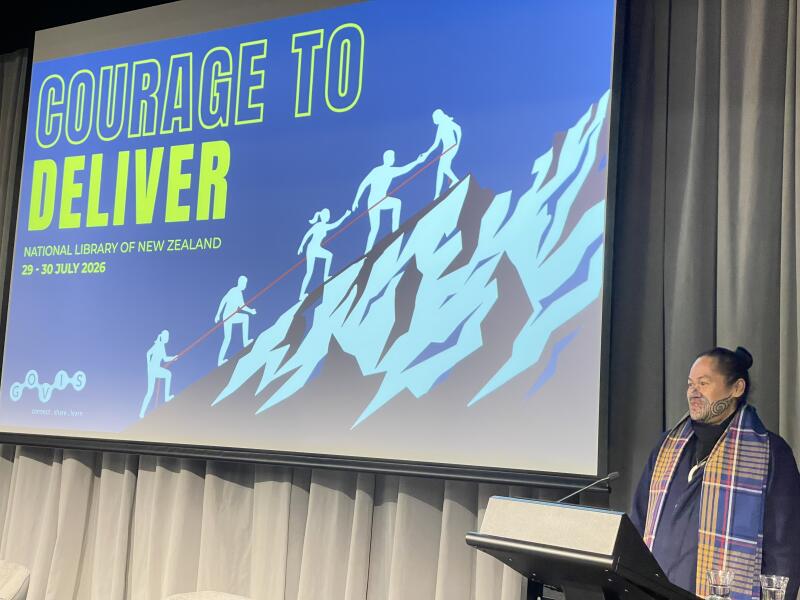
Kurt Komene speaking at a podium on stage during the GOVIS conference.
Digital public infrastructure in practice: the MyMzansi story
A central topic throughout the conference was the adoption of DPI as a foundation for scalable, secure government services.
In his keynote session, Delivering Digital Public Infrastructure for South Africa – the MyMzansi story, Silverstripe’s CEO Sigurd Magnusson shared practical takeaways from implementing reusable digital building blocks. Some examples are:
- Improving lives: Essential tasks done in minutes on a mobile phone
- Reducing cost: Enables efficient administration and protect public funds
- Connecting public and private: Unlocks opportunities for innovation
DPI allows public sector organisations to build common capabilities once and deploy them across multiple services, reducing overall cost, improving security, and ensuring data sovereignty.
By building incrementally toward a clear target state, agencies can modernise their digital footprint while reducing implementation risk.
Watch Sigurd's full presentation(opens in new tab).
Serial public sector reformer Pia Andrews also highlighted this concept during her session sponsored by Catalyst, warning against fragile "Govjenga" architectures and advocating for resilient, shared infrastructure built on public good stewardship.
Navigating AI, data sovereignty, and ethics
Artificial intelligence was a dominant theme across both days, sparking thoughtful debate on productivity gains, ethical considerations, and safety boundaries.
Key discussions included:
- AI safety and risk: Emma Humphrey from AI Safety Australia and New Zealand shared insights from Aotearoa’s first AI safety conference, calling for clear governance, critical thinking, and public standards to address rapid advancements in AI capabilities and potential security vulnerabilities.
- Redesigning work around the frontier: Dr Amanda Williamson from the Deloitte New Zealand AI Institute explained how organisations can adapt to AI’s changing capabilities, suggesting leaders treat AI prompting like employee onboarding by setting clear context and job expectations.
- Māori data and AI sovereignty: Chris Cormack from Te Kāhui Raraunga outlined the Māori Data Governance Framework, highlighting that treating data as taonga benefits everyone. Chris Cormack cautioned against bad data practices that blame, aggregate, de-contextualise, or restrict access for communities.
- National data infrastructure: Doug Dixon advocated for a sovereign National Data Infrastructure (NDI) for Aotearoa, exploring how neutral, secure rules of the road can enable safe data sharing while protecting user privacy.
Sustainability, governance, and the human cost of delivery
Delivering digital transformation requires healthy teams and capable governance. Several speakers examined the human and organisational factors that enable long-term success:
- The neuroscience of delivery: Rachael Hurren from Inde Technology broke down the metabolic cost of courage, explaining how uncertainty and high threat levels in the workplace burn cognitive energy. Rachael Hurren shared practical ways leaders can protect mental energy through clear meeting agendas, writing todo lists and plans, healthy work/life boundaries, and strategic disconnects, and the reminder for good daily sleep, exercise, and nutrition habits.
- Reframing digital governance: Murray Wills from Liverton Security and Digital Directors ANZ highlighted the governance capability gap across boards, noting that under 10% of board members have technology backgrounds and urging organisations to elevate digital expertise to executive levels, especially in light of AI.
- Practical courage in leadership: Brenda Ratcliff and Kristan Johnston from MindMeld Coaching shared practical techniques for navigating challenging public sector environments, while Ellen Twiss from the Tertiary Education Commission connected sports endurance with digital delivery, noting that real growth happens in the unseen daily preparation.
Building better digital together for Aotearoa Conference
Convenor Chris McDowall wrapped up the 2 days by bringing together the core themes: building toward a clear digital target state, designing human-centred services, upholding Te Tiriti, and navigating AI with practical governance.
At Silverstripe, we remain committed to collaborating with government agencies and enterprise partners to build secure, accessible, and resilient digital solutions. True transformation is a continuous journey that relies on strong partnership, shared values, and the courage to deliver meaningful outcomes for the people of Aotearoa.
Latest news


Did anything spark your interest?
Have you got an awesome new idea or project that you want to talk about? We're here to talk you through it.