

Teaching a new dog old tricks: Can AI be a good designer?

Let’s start with the elephant in the room: yes, AI designed the thumbnail for this blog post. I input the premise of this article into an AI agent and prompted “Create a thumbnail image for this blog post using your own judgement for how it should look and what it should contain”. And then a couple of extra prompts of “Make it worse”. It’s so bad and sloppy it’s hilarious (what is Keanu Reeves doing in there??) and it’s actually created a pastiche of itself.
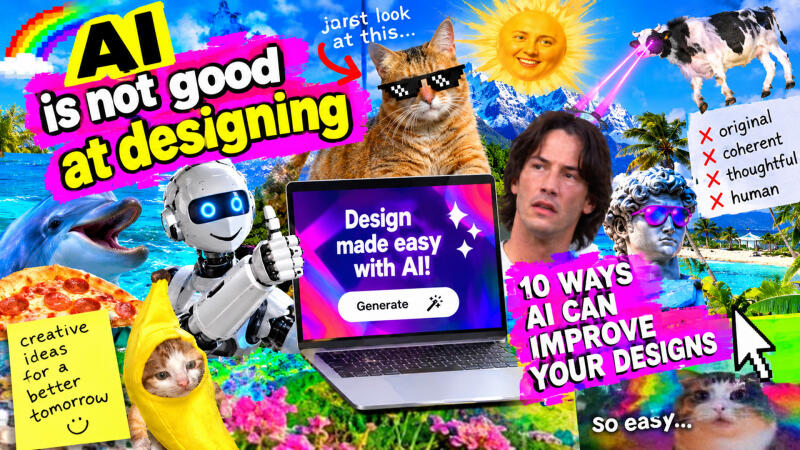
But is it good design? In this case I think it has ironically done a great job because I wanted it to look sloppy, but most people don’t want slop or poor imitations of things already out there in the world. Something I've said recently (and I’m sure someone else has said this somewhere else) is that AI design is average because it's average by design – it’s basing its decisions from what already exists, and from the most “popular” examples.
AI is so powerful and useful in so many ways, but not every way. Here’s a ridiculous football analogy I came up with. Lionel Messi is one of the greatest football players ever: shooting, pace, dribbling, passing, vision, etc. You could put him in almost any position and he would perform incredibly. Except if you put him in goal. He’s too short, has no experience and the results would be terrible. In my opinion that’s what it’s like to use AI to create designs at the moment.
AI has become remarkably good at producing things that look like design. Open a modern design tool and you can generate wireframes, interfaces, illustrations, copy and even complete websites in seconds. In Figma alone, AI can create screens from prompts, populate content, generate imagery and transform rough concepts into polished layouts. The promise is alluring: faster processes, fewer repetitive tasks and perhaps, one day, design without designers. But after spending time with these tools, I keep coming back to the same conclusion: AI isn't a good designer by itself (at least not yet).
The dog reference in the title of this blog post is more than a catchy headline. Dogs aren't born being well behaved and knowing tricks. They have to be taught by someone. The better the knowledge of the trainer, the better behaved and tricksy the dog will become. The power of the dog lies in the power of the trainer. Left alone or badly prompted the dog can become feral.
What it can feel like to design with AI
AI requires an enormous amount of guidance to produce something useful. Good AI design doesn't emerge from a blank prompt and a spark of machine creativity. It needs style guides, component libraries, design systems, UI kits, examples of existing work, brand rules and increasingly detailed instructions about what success looks like.
In other words, it needs designers.
The outputs improve in direct proportion to the amount of human thinking that precedes them. The better the design system, the more comprehensive the component library, and the more detailed the prompt, the better the result. Remove those foundations and the quality quickly deteriorates into something generic and sloppy.
This is particularly evident in tools integrated into Figma. Many of them are impressive demonstrations of automation, but most operate less like designers and more like highly efficient interns. Give them clear direction and established patterns and they can save significant amounts of time. Ask them to define a new visual language or challenge assumptions and they struggle.
This raises an important distinction between design and production. Design is not simply the arrangement of buttons, text fields and images on a screen. It involves understanding people, balancing competing needs, recognising cultural context, navigating ambiguity and occasionally ignoring the obvious answer in favour of a better one.
Great design often emerges from constraints, accidents, experience and intuition. Sometimes it comes from breaking the rules rather than following them. AI, by contrast, is essentially retrospective. It learns from what already exists and predicts what is most likely to come next. It is exceptionally good at blending but really crap at invention.
But this doesn't make AI useless to designers. Used well, AI can remove friction from the design process. It can accelerate exploration, automate repetitive work, generate starting points and help teams move from idea to discussion more quickly. The key point being that AI currently works best as a design tool rather than a designer.
For now, I think teaching a new dog old tricks still requires an old dog in the room.
Contact us at hello@silverstripe.com for design that relies on genuine creative thinking, human intuition, and expert direction.
Latest news


Did anything spark your interest?
Have you got an awesome new idea or project that you want to talk about? We're here to talk you through it.